
A short podcast clip featuring actor and environmental activist Dia Mirza has unexpectedly snowballed into one of the most talked-about social media controversies of the week. What began as a conversation about reducing plastic waste quickly turned into a heated debate over parenting, privilege, environmental awareness, and the ethics of online criticism.
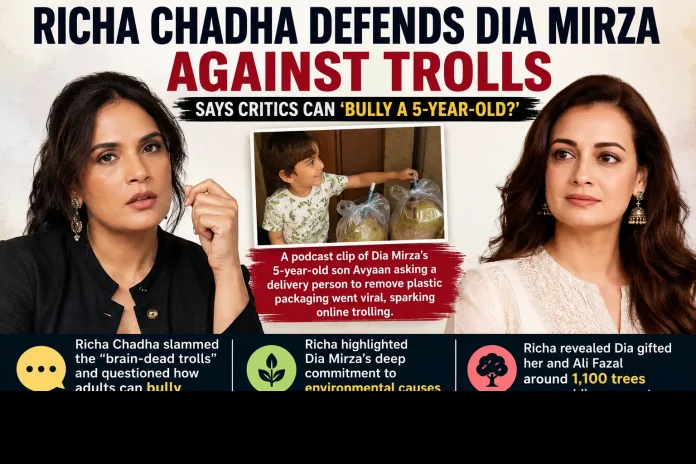
The controversy intensified further when actor Richa Chadha stepped in to defend Dia Mirza and strongly criticized internet trolls for targeting not just a celebrity, but also her five-year-old son, Avyaan.
Here’s everything you need to know about the incident, why it went viral, and what it says about the state of social media discussions today.
How the Controversy Started
The debate began after a clip from Soha Ali Khan’s podcast surfaced online. During the conversation, Dia Mirza shared an anecdote involving her five-year-old son, Avyaan Azaad Rekhi.
Dia narrated that a coconut delivery arrived at their home packed in plastic bags along with plastic straws. According to her, Avyaan opened the door and politely but firmly asked the delivery person to remove the plastic packaging because plastic was not allowed in their home.
The actress shared the incident as an example of teaching environmental responsibility from an early age. She explained that reducing single-use plastic has been an important value within their household, and she was proud that her son had understood its significance.
The podcast hosts appreciated the child’s confidence and awareness about environmental issues.
Why Social Media Reacted Strongly
Soon after the clip went viral, reactions across social media platforms became sharply divided.
Many users applauded Dia Mirza for raising an environmentally conscious child who understands the importance of avoiding single-use plastics. Supporters argued that teaching sustainability begins at home and that children should learn these values early in life.
However, another section of internet users viewed the incident differently.
Critics argued that expecting a delivery worker to handle such requests on the spot reflected privilege. Others felt the story unintentionally highlighted an unequal interaction between a celebrity household and a service worker trying to do his job.
Several posts accused Dia Mirza of being “tone-deaf,” while others questioned whether environmental activism should come at the expense of showing empathy toward workers whose packaging choices may not even be their own.
As the debate intensified, the focus gradually shifted away from plastic pollution and toward personal attacks against the actress and, unfortunately, her young son.
Richa Chadha Steps In
Actor Richa Chadha soon came to Dia Mirza’s defense after noticing the scale of online criticism.
In a strongly worded social media response, Richa questioned why adults were attacking a five-year-old child over a harmless incident.
She remarked that the “usual brain-dead suspects” had once again found a reason to troll someone online and pointed out how disturbing it was that people could end up bullying a five-year-old.
Her response shifted the conversation from the original podcast clip to a broader discussion about online behaviour and digital harassment.
Richa also questioned the impact such relentless trolling has on actors’ mental health, suggesting that celebrities often become easy targets regardless of the context.
Richa Chadha Highlights Dia Mirza’s Environmental Work
While defending her colleague, Richa Chadha also reminded people that Dia Mirza’s commitment to environmental causes goes far beyond social media conversations.
According to Richa, Dia contributes significantly toward ecological restoration and environmental conservation, saying that she does more for restoring nature in a single day than many online critics who spend their time attacking celebrities.
Richa also revealed a personal anecdote, mentioning that Dia Mirza had gifted her and Ali Fazal approximately 1,100 trees as a wedding present instead of conventional gifts.
The example was intended to demonstrate that Dia’s environmental advocacy is not merely performative but something she actively practices in her personal life.
Dia Mirza’s Long Association with Environmental Causes
For those familiar with Dia Mirza’s public work, environmental advocacy has been a consistent part of her career for many years.
She has frequently spoken about:
- Climate change
- Plastic pollution
- Sustainable living
- Wildlife conservation
- Responsible consumption
Dia has also served as a United Nations Environment Goodwill Ambassador, regularly participating in campaigns that encourage individuals and communities to reduce plastic waste and adopt sustainable habits.
Her social media platforms often feature initiatives related to tree plantation, conservation, clean beaches, and reducing single-use plastic.
Because of this long-standing activism, many supporters felt the viral podcast clip was consistent with her beliefs rather than an isolated attempt to gain attention.
The Debate Goes Beyond Plastic
The incident eventually evolved into something much larger than a discussion about plastic bags.
It raised several important questions:
Can children be taught environmental responsibility?
Many educators believe environmental values should be introduced during childhood, making recycling, waste reduction and conservation everyday habits.
Where is the line between awareness and privilege?
Some critics argued that environmental messaging should always consider the realities faced by workers who may have little control over packaging practices.
Should children become targets of online criticism?
Perhaps the biggest concern emerging from the controversy was the fact that a five-year-old child became part of social media discourse.
Even users who disagreed with Dia Mirza’s storytelling felt children should never become the subject of trolling or ridicule.
The Mental Health Conversation
Richa Chadha’s intervention also highlighted another issue that often accompanies celebrity controversies—mental health.
Public figures routinely face criticism, but viral outrage frequently escalates into personal attacks, abusive comments and harassment.
When family members, especially children, become involved, the emotional impact can be far more serious.
Mental health experts have repeatedly noted that online pile-ons create unnecessary stress not only for celebrities but also for their families, many of whom never voluntarily choose public attention.
Richa’s comments therefore resonated with many users who felt disagreements over opinions should never result in targeting minors.
Public Opinion Remains Divided
Even after Richa Chadha defended Dia Mirza, public opinion remains divided.
Supporters believe:
- Dia was simply sharing an example of environmentally conscious parenting.
- Children learning sustainability should be encouraged.
- Trolls crossed a line by targeting a five-year-old.
Critics continue to argue:
- The anecdote reflected social privilege.
- Delivery workers should not be blamed for packaging decisions.
- Environmental awareness should be balanced with empathy and practicality.
Despite these differing viewpoints, there appears to be growing agreement on one issue—children should remain outside the scope of online abuse.
Why This Story Resonated
The controversy struck a chord because it combined several emotionally charged subjects:
- Parenting
- Celebrity culture
- Environmental activism
- Social privilege
- Digital outrage
- Child welfare
Each topic carries strong opinions, making the discussion far more complex than the original podcast anecdote.
Social media often compresses nuanced conversations into short viral clips, leaving little room for context. As a result, debates frequently become polarized before viewers have watched the complete discussion.
Final Thoughts
The Dia Mirza-Richa Chadha episode demonstrates how quickly social media conversations can evolve beyond their original context. What started as a story about reducing plastic waste soon became a nationwide discussion about parenting, privilege, online behaviour, environmental activism and the responsibilities of public figures.
Richa Chadha’s defense shifted attention toward an equally important concern—the normalization of online harassment, particularly when children become unintended targets.
Whether one agrees with Dia Mirza’s approach or not, the controversy serves as a reminder that healthy public discourse should focus on ideas rather than personal attacks. Constructive criticism is a vital part of any democratic conversation, but directing hostility toward a five-year-old child crosses a line that many believe should never be blurred.
In the end, the incident has sparked conversations not only about sustainability but also about empathy, civility and the need for greater responsibility in the age of viral social media.
islamicduahub islamicduahub islamicduahub islamicduahub islamicduahub islamicduahub islamicduahub islamicduahub islamicduahub islamicduahub islamicduahub islamicduahub islamicduahub islamicduahub islamicduahub islamicduahub islamicduahub islamicduahub islamicduahub islamicduahub islamicduahub islamicduahub islamicduahub islamicduahub islamicduahub islamicduahub islamicduahub islamicduahub islamicduahub islamicduahub islamicduahub islamicduahub islamicduahub islamicduahub islamicduahub islamicduahub islamicduahub islamicduahub islamicduahub islamicduahub islamicduahub islamicduahub islamicduahub islamicduahub islamicduahub islamicduahub islamicduahub islamicduahub islamicduahub islamicduahub islamicduahub islamicduahub islamicduahub islamicduahub islamicduahub islamicduahub islamicduahub islamicduahub islamicduahub islamicduahub islamicduahub islamicduahub islamicduahub islamicduahub islamicduahub islamicduahub islamicduahub islamicduahub islamicduahub islamicduahub islamicduahub islamicduahub islamicduahub islamicduahub islamicduahub islamicduahub islamicduahub islamicduahub islamicduahub islamicduahub islamicduahub islamicduahub islamicduahub islamicduahub islamicduahub islamicduahub islamicduahub islamicduahub islamicduahub islamicduahub islamicduahub islamicduahub islamicduahub islamicduahub islamicduahub islamicduahub islamicduahub islamicduahub islamicduahub islamicduahub islamicduahub islamicduahub islamicduahub islamicduahub islamicduahub islamicduahub islamicduahub islamicduahub islamicduahub islamicduahub islamicduahub islamicduahub islamicduahub islamicduahub islamicduahub islamicduahub islamicduahub islamicduahub islamicduahub islamicduahub islamicduahub islamicduahub islamicduahub islamicduahub islamicduahub islamicduahub islamicduahub islamicduahub islamicduahub islamicduahub islamicduahub islamicduahub islamicduahub islamicduahub islamicduahub islamicduahub islamicduahub islamicduahub islamicduahub islamicduahub islamicduahub islamicduahub islamicduahub islamicduahub islamicduahub islamicduahub islamicduahub islamicduahub islamicduahub islamicduahub islamicduahub islamicduahub islamicduahub islamicduahub islamicduahub islamicduahub islamicduahub islamicduahub islamicduahub islamicduahub islamicduahub islamicduahub islamicduahub islamicduahub islamicduahub islamicduahub islamicduahub
