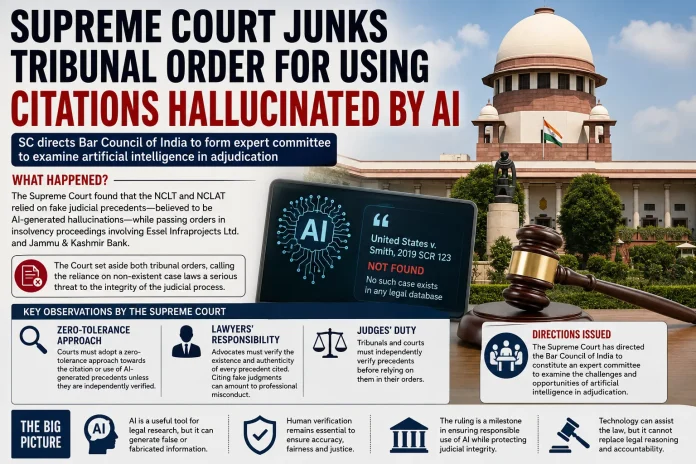

Artificial intelligence (AI) is rapidly transforming industries across the globe, including the legal profession. From legal research to drafting documents, AI-powered tools are increasingly becoming part of a lawyer’s workflow. However, a landmark ruling by the Supreme Court of India has highlighted the serious risks of relying on AI without proper human verification.
In a significant judgment delivered on July 2, 2026, the Supreme Court set aside orders passed by the National Company Law Tribunal (NCLT) and the National Company Law Appellate Tribunal (NCLAT) after discovering that the decisions relied on judicial precedents that simply did not exist. The fabricated case laws were believed to be the result of AI-generated “hallucinations”—a phenomenon in which AI systems confidently produce false or entirely fictional information.
The ruling is being viewed as one of India’s most important judicial pronouncements on the responsible use of artificial intelligence in legal proceedings.
What Was the Case About?
The case arose from insolvency proceedings involving Essel Infraprojects Ltd. and Jammu & Kashmir Bank. During the hearing, the Supreme Court found that the tribunal’s judgment had relied on several judicial precedents that were fake and could not be traced to any authentic legal database.
A Bench comprising Justice P.S. Narasimha and Justice Alok Aradhe observed that the use of fabricated legal authorities strikes at the very foundation of judicial decision-making.
Since the tribunal’s conclusions were influenced by non-existent case laws, the Supreme Court quashed both the NCLT and NCLAT orders and directed that the matter be heard afresh by the NCLT on the basis of genuine evidence and legally valid precedents.
Understanding AI Hallucinations
One of the central issues in the case was the phenomenon known as an AI “hallucination.”
Unlike deliberate misinformation, AI hallucinations occur when a generative AI system creates information that appears convincing but is entirely incorrect or fabricated. In legal contexts, this may include:
- Inventing court judgments
- Creating fake case citations
- Misquoting legal provisions
- Attributing observations to judges that were never made
Because AI models generate text by predicting likely sequences of words rather than verifying facts from official legal databases, such errors can occur if outputs are not independently checked.
The Supreme Court’s ruling serves as a reminder that AI-generated legal research must always be verified before being presented before a court.
Why the Supreme Court Took a Strict View
The Court emphasized that judicial decisions must rest on authentic legal authorities. Any reliance on fabricated precedents undermines public confidence in the justice system.
The Bench observed that judgments based on fake judicial precedents cannot be sustained in law because they compromise the integrity of the adjudicatory process itself.
The judges also stressed that courts must adopt a “zero-tolerance” approach toward the production, citation or use of AI-generated precedents unless they have been independently verified through reliable legal sources.
This observation marks a clear judicial policy that technological convenience can never replace legal accuracy.
Directions Issued to the Bar Council of India
Recognizing that artificial intelligence is becoming increasingly common in legal practice, the Supreme Court issued an important direction to the Bar Council of India (BCI).
The Court asked the BCI to constitute an expert committee to study the challenges posed by artificial intelligence in adjudication and legal practice.
The committee is expected to examine several issues, including:
- Responsible use of AI by advocates
- Verification standards for AI-assisted legal research
- Ethical obligations of lawyers using generative AI
- Guidelines for courts and tribunals
- Safeguards against fabricated legal authorities
The move is expected to lay the groundwork for future regulations governing AI usage within India’s legal ecosystem.
Professional Responsibility of Lawyers
The Supreme Court also addressed the role of advocates in ensuring the authenticity of legal submissions.
The Bench made it clear that citing AI-generated judgments without verifying their existence could amount to professional misconduct.
Lawyers have a duty to independently verify every authority cited before placing it before any court or tribunal.
The judgment reinforces an important legal principle: while technology may assist legal professionals, it cannot replace their professional responsibility.
Ultimately, accountability for court filings rests with the advocate—not with the software used to prepare them.
Responsibility of Judges and Tribunals
The ruling was equally significant in addressing the responsibilities of judicial officers.
The Court observed that judges and tribunals must exercise due diligence before relying on judicial precedents cited by parties.
Even where legal submissions appear professionally drafted, courts must ensure that cited judgments genuinely exist and are relevant to the issues before them.
This serves as a reminder that judicial decision-making requires careful human scrutiny, especially as AI tools become more sophisticated and widely accessible.
AI Is a Tool—Not a Substitute for Legal Reasoning
The Supreme Court did not reject the use of artificial intelligence altogether.
Instead, the judgment recognizes that AI can offer several benefits to the legal profession, including:
- Faster legal research
- Document summarization
- Case management
- Draft preparation
- Improved access to legal information
However, the Court drew a clear distinction between assistance and decision-making.
AI may help lawyers organize information, but it cannot independently determine legal rights or substitute verified judicial precedents.
Every AI-generated output must be reviewed, validated and accepted only after human verification.
A Global Concern
India is not the only country grappling with AI-generated legal inaccuracies.
Courts in several jurisdictions, including the United States, the United Kingdom and Australia, have recently dealt with cases where lawyers submitted briefs containing fabricated case citations generated by AI tools.
In many of these instances, courts imposed sanctions or issued stern warnings after discovering that the cited judgments either did not exist or had been misrepresented.
The Indian Supreme Court’s latest ruling aligns with this growing international consensus that AI should support—not replace—careful legal research and professional judgment.
What This Means for India’s Legal System
The judgment is likely to have far-reaching implications across the legal profession.
Law firms, advocates, tribunals and judicial academies may now strengthen their internal verification processes before relying on AI-assisted legal work.
Legal education institutions may also incorporate AI literacy into professional training, helping future lawyers understand both the capabilities and limitations of generative AI.
Technology companies developing AI solutions for legal professionals may similarly face greater expectations to improve accuracy and reduce hallucinations through stronger verification mechanisms.
Balancing Innovation with Judicial Integrity
Artificial intelligence undoubtedly has the potential to modernize India’s legal system by reducing repetitive work and improving efficiency.
Yet the Supreme Court’s decision demonstrates that innovation must never come at the cost of judicial integrity.
Courts rely on verified facts, authentic precedents and careful legal reasoning. Even a single fabricated citation can undermine confidence in an entire judgment.
The ruling therefore establishes an important principle: AI should remain an assistant to human expertise—not its replacement.
Conclusion
The Supreme Court’s decision to quash tribunal orders based on AI-hallucinated judicial precedents marks a defining moment in India’s approach to artificial intelligence and the law. By directing the Bar Council of India to frame guidelines, emphasizing professional accountability, and insisting on a zero-tolerance approach toward fabricated citations, the Court has sent a strong message that technological advancement must be accompanied by rigorous human oversight.
As AI continues to reshape legal practice, this landmark judgment offers a balanced roadmap—embracing innovation while safeguarding the credibility, fairness and integrity of the judicial process. The future of legal technology in India will likely depend not on how quickly AI is adopted, but on how responsibly it is used.
islamicduahub islamicduahub islamicduahub islamicduahub islamicduahub islamicduahub islamicduahub islamicduahub islamicduahub islamicduahub islamicduahub islamicduahub islamicduahub islamicduahub islamicduahub islamicduahub islamicduahub islamicduahub islamicduahub islamicduahub islamicduahub islamicduahub islamicduahub islamicduahub islamicduahub islamicduahub islamicduahub islamicduahub islamicduahub islamicduahub islamicduahub islamicduahub islamicduahub islamicduahub islamicduahub islamicduahub islamicduahub islamicduahub islamicduahub islamicduahub islamicduahub islamicduahub islamicduahub islamicduahub islamicduahub islamicduahub islamicduahub islamicduahub islamicduahub islamicduahub islamicduahub islamicduahub islamicduahub islamicduahub islamicduahub islamicduahub islamicduahub islamicduahub islamicduahub islamicduahub islamicduahub islamicduahub islamicduahub islamicduahub islamicduahub islamicduahub islamicduahub islamicduahub islamicduahub islamicduahub islamicduahub islamicduahub islamicduahub islamicduahub islamicduahub islamicduahub islamicduahub islamicduahub islamicduahub islamicduahub islamicduahub islamicduahub islamicduahub islamicduahub islamicduahub islamicduahub islamicduahub islamicduahub islamicduahub islamicduahub islamicduahub islamicduahub islamicduahub islamicduahub islamicduahub islamicduahub islamicduahub islamicduahub islamicduahub islamicduahub islamicduahub islamicduahub islamicduahub islamicduahub islamicduahub islamicduahub islamicduahub islamicduahub islamicduahub islamicduahub islamicduahub islamicduahub islamicduahub islamicduahub islamicduahub islamicduahub islamicduahub islamicduahub islamicduahub islamicduahub islamicduahub islamicduahub islamicduahub islamicduahub islamicduahub islamicduahub islamicduahub islamicduahub islamicduahub islamicduahub islamicduahub islamicduahub islamicduahub islamicduahub islamicduahub islamicduahub islamicduahub islamicduahub islamicduahub islamicduahub islamicduahub islamicduahub islamicduahub islamicduahub islamicduahub islamicduahub islamicduahub islamicduahub islamicduahub islamicduahub islamicduahub islamicduahub islamicduahub islamicduahub islamicduahub islamicduahub islamicduahub islamicduahub islamicduahub islamicduahub islamicduahub islamicduahub islamicduahub islamicduahub islamicduahub islamicduahub islamicduahub
